
June 2026 Product Update
July 17, 2026
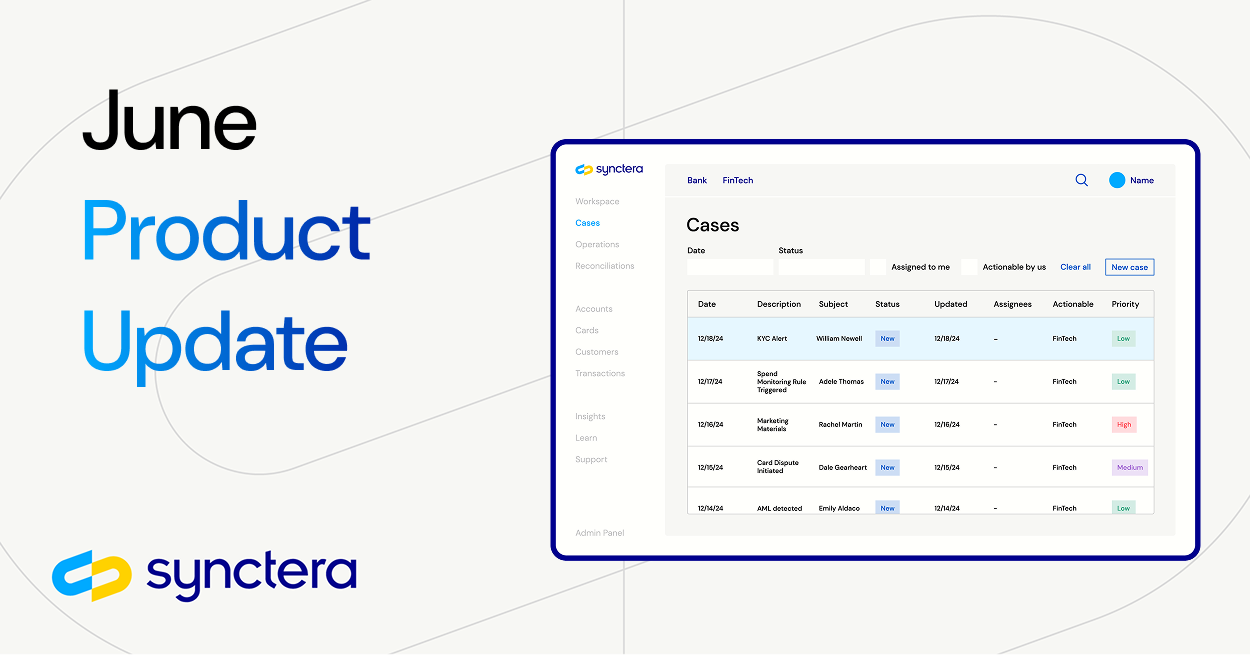


In June, Synctera launched new features that improve risk & compliance controls while making it easier for FinTechs to migrate to new sponsor banks.
These updates include:
- Supporting bank migrations with the Migration Mapping API
- Introducing Enterprise Single Sign-On (SSO) for the Synctera Console
- Improving the performance of Cable's control tests with event-driven incremental testing
- Implementing new fraud monitoring capabilities for ACH transactions
Let’s dive in!
Supporting bank migrations with the Migration Mapping API
When a FinTech moves from one sponsor bank to another on the Synctera platform, customers, accounts, and related resources need to be recreated under the new sponsor bank's tenant. With the launch of Synctera’s Migration Mapping API, Synctera’s customers now have a structured way to record and maintain the link between each old resource and its new counterpart throughout the migration and beyond.
A migration mapping is a persistent object that stores the old and new resource IDs alongside their respective tenant identifiers. FinTechs create mappings after recreating each customer or account on the new tenant with just a single API call per resource. Mappings are queryable using either the old or new API key, so operators on both sides of the transition can look up records without needing to coordinate access.
Once mappings are in place, Synctera uses them internally to coordinate downstream processes that require knowledge of both records. Webhook events fire on mapping creation, update, and deletion, giving FinTechs a hook to drive their own automation at each stage of the migration. Learn more in the Bank Migration Guide.
Introducing Enterprise Single Sign-On (SSO) for the Synctera Console
Synctera is introducing enterprise SSO for our customers and bank partners, providing teams with a simpler and more secure way to access the platform through the identity providers they already use. With this approach, authentication and MFA remain within each customer’s existing identity system (ex: Google Workspace and Microsoft Teams) rather than moving login credentials into Synctera.
Beyond login, SSO also keeps access in sync: teams can map their own role-based access controls to Synctera group IDs, so when a team grants a user a role in their identity system, that user is automatically added to the right Synctera group after login. No manual provisioning required.
IT teams can manage access centrally and work with Synctera through a guided implementation and testing process. If your team is evaluating enterprise SSO and wants to explore fit, implementation steps, or timing, please reach out to your Synctera contact to learn more.
Improving the performance of Cable's control tests with event-driven incremental testing
The control tests performed by Cable now run on a daily cadence and recompute only where new control data has actually arrived, so customers see results that reflect the latest account and transaction activity with far less lag between a change in their control data and its test result.
With each control test now evaluating the correct point-in-time state for each tested subject rather than stale or duplicated rows, it also cuts down on false positives, meaning fewer spurious flags for compliance teams to chase and more trust that a raised issue is real.
Implementing new fraud monitoring capabilities for ACH transactions
NACHA, the association that oversees the ACH network, recently implemented new operating rules for fraud and risk management. Synctera has made improvements to how ACH transactions are processed and monitored to both adhere to these rules and to ensure that our customers and bank partners have the tools in place to mitigate fraudulent transactions.
These new changes include:
- Developed new ACH transaction tags, including Payroll and Business SEC codes, which help Synctera better understand the intent of each ACH transaction. By better understanding transaction intent, the Synctera Platform can more effectively flag suspicious activity
- Automatically flagging anomalous transactions for accounts that have been open for less than 90 days
- A series of new alerts for common fraudulent transaction patterns, such as credit activity for dormant accounts, rapid outgoing transactions for newer accounts, and more
Product
Great banking products get built and scaled on Synctera’s end-to-end platform

.svg)